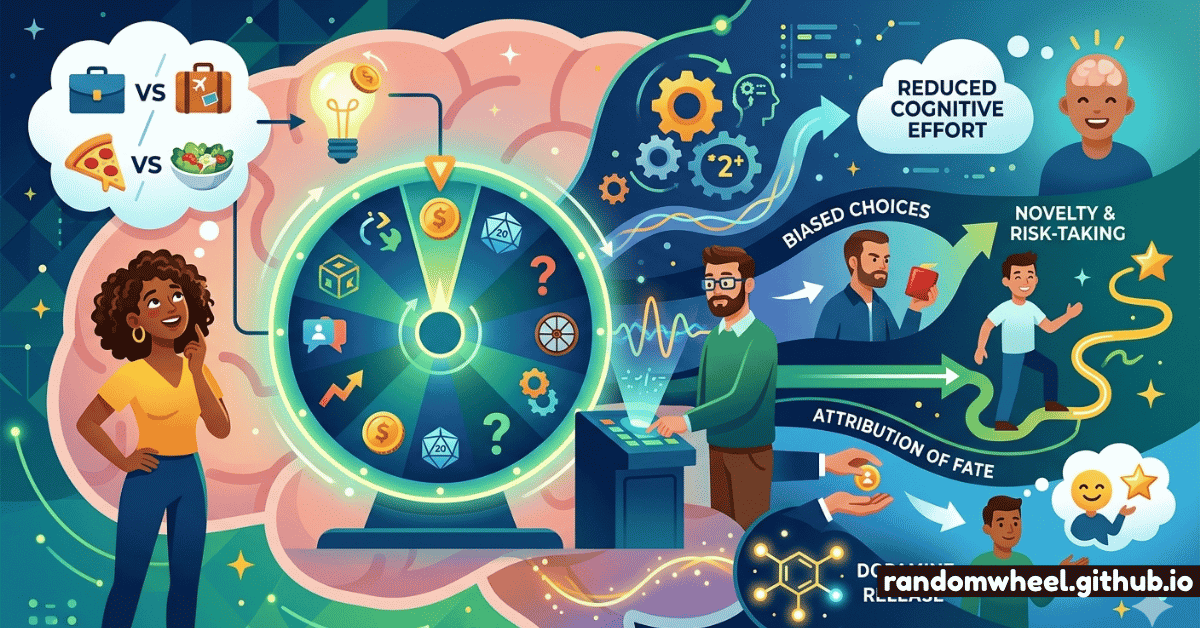
There's something almost hypnotic about watching a wheel spin. The colours blur, the ticking slows, and for a few suspended seconds, everyone in the room is completely locked in. Then — a result. Relief, laughter, disappointment, or pure delight, depending on who you ask. It's a three-second experience that feels far more significant than a coin flip or a dice roll. Why?
The answer lies deep in cognitive psychology, neuroscience, and behavioural economics. Spin wheels don't just pick randomly — they tap into some of the most powerful reward mechanisms in the human brain. In this article, we unpack the science of why random decision tools work so well, and why the humble spin wheel may be the most psychologically sophisticated version of all.
Randomness isn't just mathematically neutral — it is emotionally charged. Research in behavioural neuroscience shows that uncertain outcomes activate the brain's reward circuitry more strongly than guaranteed ones. The possibility of an outcome, not the outcome itself, is what drives engagement.
01. The Dopamine Engine: Why Uncertainty Feels Good
To understand why spin wheels are so compelling, you first need to understand dopamine — the neurotransmitter most people call the "pleasure chemical." That description is actually incomplete. Dopamine isn't primarily about pleasure; it's about anticipation and prediction.
Neuroscientist Wolfram Schultz's landmark research showed that dopamine neurons fire most intensely not when a reward arrives, but when a reward is predicted to be possible. When outcomes are uncertain — when you genuinely don't know what will happen — dopamine surges. The brain essentially treats suspense as its own form of reward.
This is precisely what a spinning wheel delivers. Between the moment the wheel is set in motion and the moment it stops, the brain is flooded with anticipatory dopamine. It's the same circuitry that makes slot machines compelling, that makes opening a mystery box exciting, and that makes a spinning wheel in a classroom make every student suddenly sit up straighter.
Spin Begins
Outcome is unpredictable
Dopamine Surge
Brain anticipates possibility
Wheel Slows
Suspense peaks — attention locks
Result Lands
Emotional response triggers
Loop Resets
Brain wants to spin again
This dopamine loop explains something every teacher and event host notices intuitively: people who have already been selected on a spin wheel often want to watch the next spin just as closely. The brain's anticipation system doesn't care whether you personally are at stake — watching others experience the loop is nearly as rewarding.
02. Choice Overload: Why Our Brains Beg for Help Deciding
In 2000, psychologists Sheena Iyengar and Mark Lepper published a now-famous study involving jam. Shoppers at a supermarket were offered either 6 types of jam or 24. The table with 24 varieties attracted more attention — but the table with 6 varieties sold 10 times more jam.
This is the paradox of choice: more options don't lead to better decisions. They lead to analysis paralysis, decision fatigue, and — critically — lower satisfaction even when a choice is finally made. The more options we face, the more we second-guess ourselves afterward.
Psychologist Barry Schwartz coined this term to describe how an abundance of options increases the opportunity cost of any single choice — making even a good decision feel like a potential mistake. When a wheel decides for you, this cognitive burden evaporates entirely.
This is exactly why a spin wheel is so genuinely relieving for everyday decisions — what to eat for dinner, which movie to watch, where to go on the weekend. The wheel doesn't just save time. It saves the mental energy that would have been spent deliberating, and it removes the post-decision regret that haunts freely-made choices. When the wheel decided, there's nothing to second-guess.
03. Cognitive Biases That Spin Wheels Neutralise
Human decision-making is riddled with systematic errors — cognitive biases that skew our choices in predictable, often irrational directions. Randomness is one of the few mechanisms that bypasses these biases entirely. Here are the major ones a spin wheel reliably defeats:
| Cognitive Bias | What It Does | How the Wheel Fixes It |
|---|---|---|
| Status Quo Bias | We default to familiar options — same restaurant, same activity, same answer. | Forces genuine variety — the wheel treats every option equally regardless of familiarity. |
| Availability Heuristic | We overweight options we can easily recall, ignoring equally valid alternatives. | Equalises visibility — every segment on the wheel has identical probability, not just the memorable ones. |
| Anchoring Bias | The first option mentioned disproportionately shapes the final choice. | Position is irrelevant — wheel segment order has zero effect on selection probability. |
| Conformity Bias | We shift toward what we think others want, even when we have a genuine preference. | No social signal to follow — the wheel's result carries no social information to conform to. |
| Sunk Cost Fallacy | Previous investments make us reluctant to change course even when logic says to. | Clean slate every spin — the wheel has no memory of previous decisions to honour. |
| Decision Fatigue | Our decision quality degrades significantly after many consecutive choices. | Zero cognitive cost — delegating the decision to the wheel completely preserves mental resources. |
"A well-designed random tool doesn't just make decisions faster — it makes them genuinely fairer by removing every systematic bias the human brain brings to the table."
04. The Psychology of Perceived Fairness
One of the most underappreciated reasons spin wheels work is their social and moral power. Humans are extraordinarily sensitive to fairness — studies in behavioural economics show that people will accept a worse absolute outcome if it means a fairer process. We'd rather get less from a fair system than more from a biased one.
This explains why groups consistently accept wheel results even when the outcome isn't their preference. In classrooms, students who get called on by a wheel don't resent the teacher the way they might if the teacher chose them directly. In giveaways, audiences who didn't win accept the result far more readily when they watched a transparent spin than when a winner was announced without a visible process.
The spin wheel externalises the decision entirely. When the wheel decides, no human is responsible for the outcome — which removes resentment, accusation, and social friction from situations that might otherwise breed them. This is what social scientists call procedural justice: the fairness of the process matters as much as — sometimes more than — the fairness of the result.
Research by Thibaut and Walker established that people's satisfaction with outcomes is heavily determined by how fair they perceive the process to be. A spin wheel scores near-perfectly on every measure of procedural fairness: it is transparent, consistent, unbiased, and gives equal consideration to all participants.
05. Gamification and the Power of Ritual
Beyond neuroscience and behavioural economics, there's a simpler truth: spin wheels are fun. And that matters enormously for engagement, compliance, and memory.
Gamification research consistently shows that adding game-like elements — unpredictability, visual feedback, an element of chance — to non-game contexts dramatically increases participation, attention, and enjoyment. The spin wheel is one of the purest gamification tools available precisely because it requires no modification to the underlying task. The task itself doesn't change; the wrapper around it does.
There's also something powerful in the ritual aspect of a spin. Anthropologists note that humans use rituals to mark transitions — between states of not-knowing and knowing, between individual preference and collective decision. The visual drama of a spinning wheel serves this function perfectly. It creates a clear before (deliberation) and after (resolution) with a satisfying, shared spectacle in between.
Variable Reward
Unpredictable rewards are far more engaging than fixed ones — the same principle that makes games compelling.
Visual Salience
Motion and colour command attention instinctively. A spinning wheel is impossible to ignore in a room.
Shared Experience
Collective suspense creates social bonding. Watching together synchronises emotions across a group.
Cognitive Relief
Delegating decisions to an external tool relieves the mental burden of choice — immediately reducing stress.
Perceived Fairness
Random selection feels inherently just. Participants trust and accept results from a process nobody controls.
Ritual Closure
The spin creates a clear decision moment — converting open-ended deliberation into definitive resolution.
06. Where These Psychological Effects Matter Most
Understanding the psychology helps explain why spin wheels improve outcomes in such a wide variety of real-world contexts:
Classrooms & Learning Environments
The dopamine response to possible selection keeps all students alert — not just the one who was called. The perceived fairness eliminates resentment, and the ritual creates memorable lesson moments that anchor information in long-term memory through emotional association.
Business Decisions & Team Meetings
Groups often get stuck in deliberation loops where social dynamics — hierarchy, conformity bias, loudest voice — override good judgment. A spin wheel breaks the deadlock while giving everyone a procedurally fair reason to accept and commit to the outcome, reducing post-decision second-guessing.
Games, Events & Giveaways
The dopamine loop and variable reward mechanism make spin wheels the most psychologically engaging draw format available. Audiences don't just watch — they feel it. The transparent, unbiased nature of the spin also eliminates post-event suspicion, protecting brand and community trust.
Everyday Personal Decisions
For decisions where all options are genuinely acceptable (where to eat, what to watch, which task to do first), a spin wheel removes decision fatigue entirely. It also provides a useful emotional litmus test: if you spin and feel immediate disappointment, you actually know which option you preferred all along.
Mental Wellbeing & Anxiety Reduction
Chronic decision fatigue is a genuine contributor to daily stress and cognitive exhaustion. Regularly delegating low-stakes decisions to a randomisation tool preserves mental bandwidth for higher-stakes choices. Cognitive load research consistently shows that reduced trivial decision volume improves performance on important tasks.
07. Why a Spinning Wheel Specifically — Not Just Any Random Tool
Randomness alone doesn't account for the spin wheel's special appeal. A random number generator is equally random — but it produces none of the engagement, shared experience, or emotional resonance of a wheel. So what makes the spinning wheel format uniquely effective?
The deceleration effect
Unlike a dice roll or a button press, a spin wheel slows down visibly before producing its result. This deceleration is psychologically critical. As the wheel slows, uncertainty narrows — outcomes become increasingly probable before becoming definitive. Each passing second of slowing gives the brain a new probability to process. This extended anticipation period multiplies the dopamine exposure compared to an instant result, making the eventual landing feel far more significant and satisfying.
The visual equality of segments
When every option is a visible, equally-sized segment on a wheel, participants can see fairness rather than just being told about it. This visual representation of equal probability is uniquely convincing to the human visual system, which trusts spatial equality more intuitively than abstract numerical claims like "each option has a 1-in-8 chance."
The social performance aspect
A spinning wheel is a shared spectacle. It can be pointed at, projected on a screen, watched collectively. This transforms a private computational act (random selection) into a public ritual — one that bonds the group through shared anticipation and shared reaction. No other randomisation tool has this quality to the same degree.
The most effective spin wheels include a ticking or clicking sound during the spin. This is not cosmetic — the auditory cue provides an additional sensory channel for the deceleration effect, making the slowing-down phase even more emotionally engaging. Sound and motion together produce a multi-sensory anticipation experience that neither channel achieves alone.
Experience the Psychology Yourself 🎡
There's no better way to understand the dopamine loop than to feel it. Try our free spin wheel — you'll notice the anticipation the moment the wheel starts slowing.
Spin The Wheel — Free08. When Randomness Isn't the Right Tool
In fairness to psychology, it's worth noting where random decision tools have limits. Spin wheels work brilliantly when options are genuinely equivalent, or when procedural fairness matters more than optimisation. They're less appropriate when:
- Expertise matters: Randomly assigning complex medical, legal, or financial decisions ignores relevant domain knowledge that should inform the outcome.
- Reversibility is low: For genuinely high-stakes, hard-to-reverse decisions, the relief of delegation isn't worth the risk of a suboptimal outcome. Use the wheel as a tiebreaker after deliberation, not as a replacement for it.
- Preferences are strong and unequal: If one option is truly significantly preferable to all others, the spin wheel may produce a worse outcome. In these cases, the "spin and check your reaction" method is useful — let the wheel spin, then honour your gut feeling about the result.
Used in the right contexts, however, random decision tools don't just save time — they save relationships, preserve fairness, reduce cognitive load, and make the act of deciding genuinely enjoyable. That's a remarkable set of benefits for something as simple as a spinning circle.