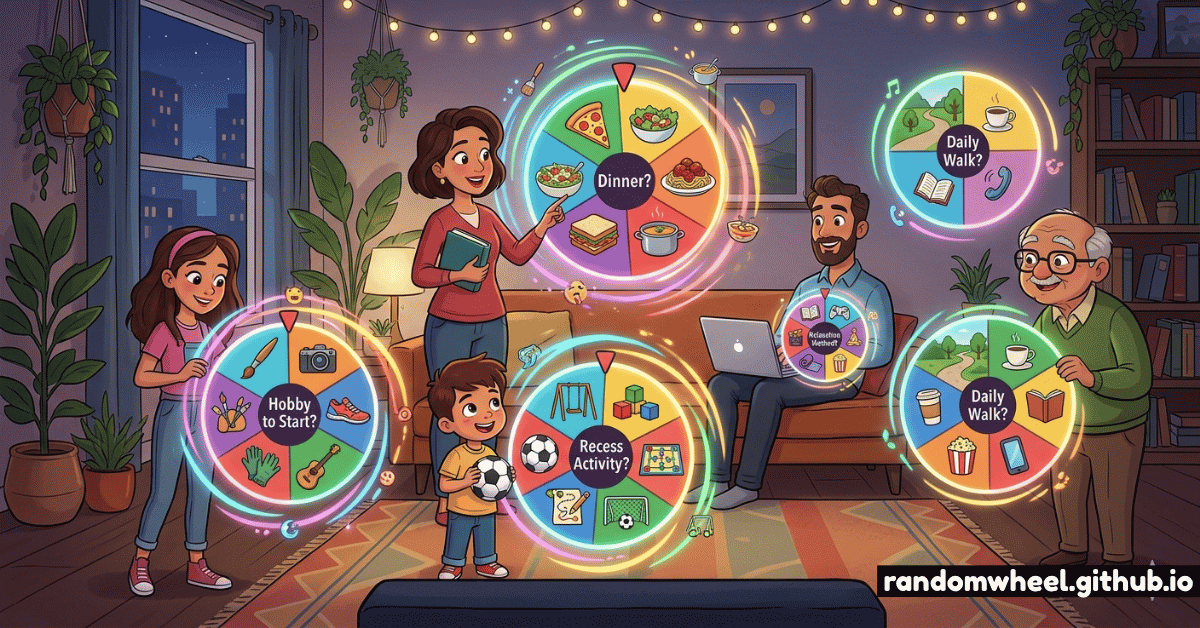
By the time most of us reach the evening, we've already made hundreds of small decisions — what to wear, what to eat for breakfast, which route to take, which email to answer first. Each one draws on the same finite pool of mental energy. By the time something that actually matters needs our attention, that pool is dangerously low. This is decision fatigue, and it quietly ruins productivity, relationships, and wellbeing for millions of people every day.
The good news: you don't have to fix your entire lifestyle to start recovering that energy. A simple decision-making wheel — customised for the recurring choices that drain you most — can instantly eliminate dozens of micro-decisions per day. Here's everything you need to know to start using one effectively.
01. What Is Decision Fatigue — And Why Does It Matter?
Decision fatigue is the psychological deterioration in the quality of decisions made after a long session of decision-making. Unlike physical fatigue, which we recognise and respond to, decision fatigue is almost entirely invisible. We don't feel tired — we just start making worse choices. We opt for the easiest option, defer indefinitely, or make impulsive decisions we later regret.
The phenomenon was famously documented in a study of Israeli parole judges who granted parole to roughly 65% of prisoners early in the day but dropped to nearly 0% by the end of a session — regardless of case merit. The judges weren't biased; they were exhausted. When the brain runs low on decision-making fuel, it defaults to the safest, lowest-effort option. For a judge, that's "no." For you, it might be ordering junk food, snapping at someone you care about, or just staring at Netflix for 40 minutes before giving up and going to bed.
Decision fatigue operates independently of general tiredness. You can feel physically rested and still have severely depleted decision capacity — particularly after a busy morning of emails, meetings, and minor workplace choices. The mental resource most depleted is executive function, not energy in the traditional sense.
02. How a Decision Wheel Directly Combats Fatigue
A decision wheel works because it eliminates the deliberation process entirely for low-stakes choices. Deliberation — the internal weighing of pros and cons — is the single most cognitively expensive part of any decision. When the wheel decides, you skip it completely. The result is immediate, authoritative, and genuinely random — which means it's also fair and easy to accept.
Crucially, a decision wheel works best for decisions where all options are approximately equal in value — the kind of choices that shouldn't really take mental energy at all, but somehow do. Research on ego depletion (the theory that willpower and decision-making draw on the same resource) shows that automating low-stakes decisions is the most efficient way to preserve cognitive bandwidth for decisions that genuinely matter.
- 15 minutes debating what to cook for dinner
- Scrolling Netflix for 40 mins, picking nothing
- Group chat spiralling: "idk, what do YOU want?"
- Defaulting to the same safe option every time
- Feeling vaguely drained by 7pm for no clear reason
- Post-decision regret: "we should've picked the other thing"
- Dinner decided in 3 seconds — no negotiation
- Movie chosen before you even sit down
- Group accepts the wheel result immediately
- Variety naturally built into routine choices
- Mental energy preserved for meaningful decisions
- No one to blame — the wheel chose, everyone commits
"I built a 'what's for dinner' wheel with 12 meals we all love. We haven't had a single argument about food in three months. It sounds ridiculous how much that one change improved our evenings."
03. 6 Best Decision-Making Wheels for Everyday Life
The most effective approach is to build dedicated wheels for your most recurring decision categories. Here are the six that consistently make the biggest difference to daily life — with ready-to-use example segments for each:
What's For Dinner Wheel
The single most popular use case. Load your household's favourite meals — everyone pre-approves the list, so whatever lands is genuinely welcome.
What to Watch Tonight Wheel
End the "what should we watch" paralysis forever. Add shows and films from your watchlist — spin instead of scroll.
Daily Workout Wheel
No more skipping because you couldn't decide what to do. The wheel picks your workout style — removes the activation energy barrier entirely.
Which Task First Wheel
When your to-do list has five equally important items and you're staring at it in paralysis — spin. Commit to whichever lands for the next 45 minutes.
Weekend Activity Wheel
Kills the Friday evening "so… what do you want to do this weekend?" loop. Pre-load options you're all genuinely excited about and let the wheel break the tie.
Evening Wind-Down Wheel
When you're too tired to decide how to relax, the wheel gives you permission to actually decompress — no guilt about the "right" choice.
04. How to Build Your Personal Decision System
The goal isn't to spin a wheel for every choice — it's to identify the specific recurring decisions that drain you disproportionately and automate exactly those. Here's a simple process to build a system that sticks:
Audit your decision drain points
For one week, notice the moments when you feel stuck, irritable, or disproportionately tired from a simple choice. Common culprits: meal planning, task prioritisation, weekend plans, entertainment, and what to wear. These are your candidates for wheel automation.
Build consensus before you build the wheel
If others are affected by the decision (family members, housemates, colleagues), involve them in curating the wheel's options before the first spin. A wheel only works if everyone has pre-approved the entire option set — otherwise the result will be contested.
Keep wheels lean — 6 to 12 options maximum
Ironically, too many options on the wheel reintroduces a form of choice overload. Aim for 6–12 genuinely distinct segments. If you have 20 favourite meals, create two wheels: a "weeknight" and a "weekend" version. Specificity makes wheels faster and more useful.
Establish a "one re-spin" rule — and stick to it
Allow yourself or your group a single re-spin per session, no questions asked. But commit to the second result absolutely. This rule preserves a small amount of agency while preventing the wheel from being spun indefinitely until it lands on someone's secret preference — which defeats the entire purpose.
Review and refresh your wheels quarterly
Tastes change, circumstances change, and a stale wheel stops being useful. Set a quarterly reminder to review each wheel's options — remove things that no longer excite you and add new options you've discovered since the last update. Keeping the wheel current is what keeps it relevant.
05. Decision Wheels for Couples, Families & Teams
The fairness dimension of a decision wheel is arguably its greatest power in group settings. Recurring group decisions — what to cook, where to go, whose preference wins this time — are a primary source of low-level friction in relationships. The wheel removes the social negotiation entirely by externalising the authority.
For couples
The classic "where should we eat?" debate is the most common use case, but the wheel's power runs deeper. Couples who use decision wheels for recurring choices report fewer small resentments building up over time — because no one person is always getting their way, and no one is always compromising. The wheel is a genuinely neutral third party, and that neutrality has real emotional value.
Try a joint "date night" wheel with activities you've both pre-approved — the person who would typically defer to their partner's preference often finds the wheel liberating because it gives them an outcome they can genuinely embrace rather than just accept.
For families with children
Children have an acute sense of fairness and an equally acute ability to escalate disputes over minor decisions. A family wheel — for choosing Friday night films, deciding whose turn it is to pick a restaurant, or selecting a weekend activity — works brilliantly because children trust the wheel's fairness instinctively. It also teaches an early lesson in accepting outcomes gracefully when a transparent process was followed.
For workplace teams
Team indecision is expensive. Meetings that spiral on minor questions like "who presents first?", "which format do we use?", or "what should we order for the team lunch?" waste collective time and energy. A shared team wheel for recurring micro-decisions saves meeting time and models decisiveness as a team value.
When you're genuinely unsure which of two options you prefer, use the wheel as a feeling-revealer, not a final decider. Spin it. Notice your immediate emotional reaction to the result — relief, disappointment, or excitement. That reaction tells you which option you actually want. Then choose accordingly. The spin surfaces a preference you couldn't consciously access.
06. Advanced Strategies for Power Users
Once basic wheels are working well, these advanced configurations dramatically increase their value:
- Weighted segments for variety management. If you want one option to appear roughly twice as often — say, "Cook at home" vs "Takeout" — simply add it twice. The wheel's probability naturally reflects the count of segments.
- Seasonal wheel rotation. Create spring/summer and autumn/winter versions of activity and meal wheels. Seasonal variety keeps the options feeling fresh and contextually appropriate.
- Tiered decision wheels. Build a "category" wheel that selects a broad domain (Italian, Asian, Comfort Food), then spin a second wheel within that category for a specific dish. The two-spin process adds suspense while keeping each wheel simple.
- The "wildcard" segment. Include one segment labelled "Wildcard" or "Try Something New" on every wheel. When it lands, the rule is to choose something genuinely novel — not from the existing list. This prevents any wheel from calcifying into predictability.
- Energy-matched wheels. Build separate wheels for "high energy" and "low energy" days. On days when you're depleted, the low-energy wheel automatically suggests gentler options — without requiring you to assess your energy level and make yet another decision about it.
07. Knowing What NOT to Delegate to a Wheel
A decision wheel is a tool for low-stakes, reversible, preference-equivalent choices. It is not appropriate for decisions where outcomes are meaningfully different in ways that matter — career choices, major financial decisions, medical options, or relationship-defining moments. Using a wheel for these trivialises them and can genuinely lead to worse outcomes than deliberation would.
Before spinning, ask yourself: "Would I be genuinely OK with any result on this wheel?" If the honest answer is yes — spin away. If there's one option you'd really prefer or one you'd genuinely regret, the wheel isn't the right tool. Use it only where the options are truly interchangeable in terms of what matters to you.
Used correctly and consistently, a decision wheel isn't a gimmick — it's a genuine cognitive productivity tool that recovers real mental bandwidth every single day. The hours you reclaim from indecision accumulate. The relationships you protect from the friction of minor disagreements compound over time. And the mental energy you preserve for the decisions that actually shape your life is perhaps the most valuable resource you can give yourself.
Build Your First Decision Wheel Today 🌿
Free, instant, no sign-up. Add your options in seconds, spin, and reclaim your mental energy for things that actually matter.
Launch Decision Wheel — Free